
Understanding electrical units is essential for anyone choosing a solar panel, generator, or home backup system — and confusing for almost everyone who tries. This guide explains every common electrical unit clearly, with the exact formulas, worked examples, and real-world context. No engineering degree required.
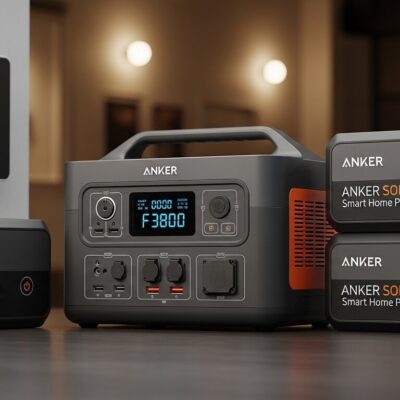
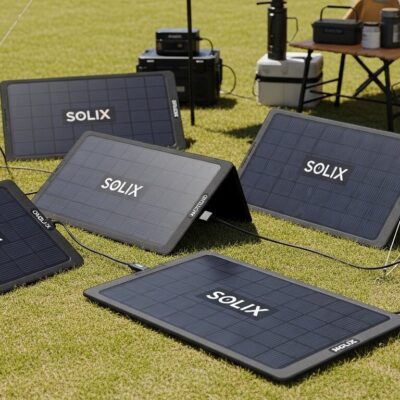
We use Anker SOLIX products as real-world examples throughout — their F3800 (6,000W, 120V/240V) and solar panels (100W–400W) are perfect teaching tools because their specs appear in common search questions about watts, amps, and volts.
#1 — What Are Watts? The Foundation of Electrical Power
The most important electrical unit — and the one most people half-understand.
What Are Watts, Really?
A watt is the unit of electrical power — specifically, it measures the rate at which electrical energy is consumed or produced. One watt equals one joule of energy per second. In practical terms: a 100W lightbulb consumes 100 joules of energy every second it is switched on. A 6,000W generator (like the Anker SOLIX F3800’s output) delivers 6,000 joules per second — enough to run 60 standard lightbulbs simultaneously.
Watts vs Watt-Hours: Power vs Energy
This distinction causes enormous confusion. Watts measure power — the rate of energy use at any given moment. Watt-hours (Wh) measure energy — the total amount consumed or stored over time.
- A 100W appliance running for 1 hour uses 100 Wh (100 watt-hours) of energy
- A 100W appliance running for 10 hours uses 1,000 Wh = 1 kWh (kilowatt-hour)
- Your electricity bill charges you per kWh — not per watt
- The Anker SOLIX F3800 stores 3,840 Wh — it can deliver 3,840 Wh of energy in total
If you run a 500W load on the F3800, it will last approximately 3,840 Wh ÷ 500W = 7.7 hours.
| ⚡ Quick Reference Power formula: Watts = Volts × Amps Energy formula: Watt-hours = Watts × Hours Cost formula: kWh = Watt-hours ÷ 1,000 F3800 capacity: 3,840 Wh = 3.84 kWh Daily home use (average): ~30 kWh = 30,000 Wh |
#2 — Watts to Amps: Formula, Calculator & Real Examples
18,100 monthly searches — the most common electrical conversion question.
Watts to Amps Formula
The relationship between watts, amps, and volts is Ohm’s Law:
Amps = Watts ÷ Volts
To convert watts to amps, divide the wattage by the voltage of the circuit. US household circuits are either 120V (standard outlets) or 240V (large appliances). European and international circuits are typically 230V.
WATTS TO AMPS — COMMON EXAMPLES (120V US CIRCUIT)
| 100W lightbulb: 100 ÷ 120 = 0.83 amps 500W hair dryer: 500 ÷ 120 = 4.17 amps 1,000W microwave: 1,000 ÷ 120 = 8.33 amps 1,500W space heater: 1,500 ÷ 120 = 12.5 amps Anker SOLIX PS100 (100W panel): 100 ÷ 18V (panel voltage) = 5.56 amps output Anker SOLIX F3800 (6,000W at 240V): 6,000 ÷ 240 = 25 amps |
1,500 Watts to Amps: The Most Common Calculation
Space heaters, hair dryers, and small ovens commonly run at 1,500W — the maximum safe load for a standard 15-amp 120V US outlet. At 120V: 1,500W ÷ 120V = 12.5 amps — safely within a 15-amp circuit’s 80% continuous load limit of 12 amps. Note: the 80% rule means a 15-amp circuit should not carry more than 12 amps continuously; a 1,500W heater is borderline and should be on a dedicated circuit.
How to Calculate Amps from Watts: Step-by-Step
Step 1: Identify the wattage of your appliance (usually on the label or in the manual). Step 2: Identify the circuit voltage (120V for standard US outlets, 240V for large appliances). Step 3: Divide watts by volts: Amps = Watts ÷ Volts. Step 4: Compare result to your circuit’s breaker rating — ensure you are below 80% of the breaker’s amperage for continuous loads.
Amp to Watts Calculator: The Reverse Calculation
To convert amps to watts, multiply by voltage: Watts = Amps × Volts. Examples at 120V:
- 15-amp circuit maximum continuous load (80%): 15 × 0.8 × 120 = 1,440W
- 20-amp circuit maximum continuous load (80%): 20 × 0.8 × 120 = 1,920W
- Anker SOLIX F3800 solar input (20A at 120V equivalent): approximately 2,400W
#3 — Amps vs Volts: What’s the Difference?
3,600 monthly searches — the relationship between current and voltage explained simply.
What Are Amps?
Amperes (amps) measure electrical current — the flow rate of electrons through a conductor. If electricity were water flowing through a pipe, amps would measure how much water is flowing per second. Higher amperage = more electrons moving = more current flowing. Circuit breakers protect circuits by tripping when current exceeds the safe limit for the wire (e.g., a 20-amp breaker on a circuit wired with 12-gauge wire).
Amps vs Volts: The Water Analogy
Volts measure electrical pressure — the force pushing electrons through the conductor. Using the water analogy: volts are the water pressure, amps are the flow rate. Together, they determine wattage (power): Watts = Volts × Amps. A high-voltage, low-current connection (like a 240V dryer circuit) carries the same power as a low-voltage, high-current connection at a lower voltage — but the high-voltage option is more efficient over long distances.
VOLTS VS AMPS VS WATTS: QUICK REFERENCE
| Volts: Electrical pressure — pushes current through the circuit Amps: Electrical current — flow rate of electrons Watts: Electrical power — rate of energy consumption or production Formula: Watts = Volts × Amps (and rearranges to: Amps = W÷V, Volts = W÷A) 120V vs 240V: US homes have both — 120V for outlets, 240V for large appliances Anker SOLIX F3800: Outputs both 120V and 240V — covers all household appliances |
Volts vs Amps: Which Matters More for Home Backup?
Both matter equally — but voltage determines which appliances you can run. A 120V-only backup system cannot power 240V appliances (electric dryers, central HVAC, EV chargers). The Anker SOLIX F3800’s 120V/240V split-phase output is specifically designed to cover the full voltage range of a US home — this is one of its key differentiators from competitors that offer only 120V output.
#4 — KVA to Amps: How to Convert (With Examples)
4,400 monthly searches — KVA appears on generators and UPS systems. Here’s what it means.
What is KVA?
KVA (kilovolt-amperes) is a unit of apparent power — the total power drawn by a circuit including both the working power (watts) and reactive power (caused by inductance in motors and transformers). In purely resistive loads (heaters, lightbulbs), KVA and kW are equal. In loads with motors (air conditioners, refrigerators, power tools), KVA is higher than kW due to the power factor — the ratio of real power to apparent power.
KVA to Amps Formula
Amps = (KVA × 1,000) ÷ Volts
KVA TO AMPS EXAMPLES
| 1 KVA at 120V: (1 × 1,000) ÷ 120 = 8.33 amps 5 KVA at 120V: (5 × 1,000) ÷ 120 = 41.7 amps 5 KVA at 240V: (5 × 1,000) ÷ 240 = 20.8 amps Anker SOLIX F3800 (6kW at 240V): 6,000 ÷ 240 = 25 amps (= 6 KVA at unity power factor) |
KVA vs KW: Why Generators Are Rated in KVA
Generator manufacturers use KVA ratings because the actual usable power (kW) depends on the power factor of the connected loads — which they cannot control. A 5 KVA generator with a 0.8 power factor delivers 4 kW of usable power. Anker SOLIX rates the F3800 in watts (6,000W) at unity power factor — a more honest representation of actual usable power for typical home loads.
#5 — Horsepower to Watts: The Conversion Explained
4,400 monthly searches — motors and engines use HP; electrical systems use watts. Here’s the bridge.
Horsepower and Watt: The Formula
Watts = Horsepower × 746
One mechanical horsepower equals exactly 745.7 watts — conventionally rounded to 746W. This conversion originates from James Watt’s 18th-century measurements of how much power a horse could sustain over time. The unit was designed to market Watt’s steam engines by expressing their output in terms people already understood.
HORSEPOWER TO WATTS — COMMON EXAMPLES
| 1 HP motor: 1 × 746 = 746W 5 HP well pump: 5 × 746 = 3,730W 10 HP workshop compressor: 10 × 746 = 7,460W Anker SOLIX F3800 (6,000W): 6,000 ÷ 746 = 8.04 horsepower equivalent output 150W refrigerator motor: 150 ÷ 746 = 0.2 HP |
Why HP to Watts Matters for Choosing a Backup System
If you need to run a well pump (5 HP = 3,730W) or a workshop air compressor (10 HP = 7,460W) from backup power, you need a system rated above that wattage for continuous use — plus additional capacity for startup surges (motors typically surge to 3× their running wattage at startup). The Anker SOLIX F3800 at 6,000W handles any appliance up to approximately 8 HP continuously, with surge capacity for larger startup loads.
#6 — Watts to Joules, Lumens to Watts & Other Conversions
Completing the electrical unit picture — energy, light, and unit relationships.
Watts to Joules: Energy Over Time
Joules measure energy — the total amount of work done. Watts measure power — the rate at which work is done. The relationship: 1 watt = 1 joule per second, therefore Joules = Watts × Seconds.
| ⚡ Quick Reference Joules from watts: Joules = Watts × Seconds 1 watt for 1 second: = 1 joule 100W lightbulb for 1 hour: = 100 × 3,600 = 360,000 joules = 100 Wh F3800 total energy (3,840 Wh): = 3,840 × 3,600 = 13,824,000 joules 1 kWh: = 3,600,000 joules = 3.6 MJ |
Lumens to Watts: How Much Light Per Watt?
Lumens measure the total amount of visible light output. Watts measure power consumption. The lumens-to-watts ratio varies dramatically between bulb types:
| Incandescent bulb: 10–15 lumens per watt (very inefficient) CFL (compact fluorescent): 50–70 lumens per watt LED bulb: 80–100+ lumens per watt (most efficient) For 800 lumens (standard 60W equivalent): LED: requires only 8–10W · Incandescent: required 60W Anker SOLIX F3800 running LED lights: 6,000W ÷ 10W per LED = 600 LED bulbs simultaneously |
What is mAh? Battery Capacity Explained
mAh (milliampere-hours) measures the capacity of a battery — specifically, how many milliamps it can deliver for one hour. It is the standard unit for small batteries (phone batteries are typically 3,000–5,000 mAh; AA batteries are approximately 2,500 mAh). To convert mAh to Wh (the unit used for power station capacity): Wh = mAh × Volts ÷ 1,000.
| ⚡ Quick Reference mAh to Wh: Wh = mAh × Volts ÷ 1,000 iPhone 15 battery (3,349 mAh at 3.85V): 3,349 × 3.85 ÷ 1,000 = 12.9 Wh F3800 in mAh (at 12V equivalent): 3,840 Wh × 1,000 ÷ 12 = 320,000 mAh F3800 phone charges: 3,840 Wh ÷ 12.9 Wh per charge = approximately 300 iPhone charges |
What is a Power Bank? (And How It Differs from Anker SOLIX)
A power bank is a portable battery with USB outputs designed for charging phones, tablets, and small devices. Consumer power banks typically range from 10,000 mAh (37 Wh) to 30,000 mAh (111 Wh) and cost $20–$100. Anker SOLIX power stations are fundamentally different — they are large-capacity battery systems with AC outlets that power household appliances, not just USB devices. The F3800’s 3,840 Wh is approximately 35–100× the capacity of a consumer power bank.
| 🛒 Anker SOLIX Power Stations — From Power Banks to Whole-Home Backup C800 (768Wh) · C1000 (1,056Wh) · F3800 (3,840Wh) · E10 (6,000Wh–30,000Wh). → Shop on Anker SOLIX |
Final Reference: All Electrical Conversion Formulas
Quick reference for every formula covered in this guide:
| Convert from | Convert to | Formula |
| Watts (W) | Amps (A) | Amps = Watts ÷ Volts |
| Amps (A) | Watts (W) | Watts = Amps × Volts |
| Watts (W) | Kilowatts (kW) | kW = Watts ÷ 1,000 |
| Watts (W) | Joules (J) | Joules = Watts × Seconds |
| Watt-hours (Wh) | Kilowatt-hours (kWh) | kWh = Wh ÷ 1,000 |
| KVA | Amps | Amps = (KVA × 1,000) ÷ Volts |
| Horsepower (HP) | Watts (W) | Watts = HP × 746 |
| Watts (W) | Horsepower (HP) | HP = Watts ÷ 746 |
| mAh | Watt-hours (Wh) | Wh = mAh × Volts ÷ 1,000 |
| Lumens | Watts (LED) | Watts = Lumens ÷ 100 (approx) |
| 🛒 Anker SOLIX — Put These Formulas to Work Calculate your home’s wattage needs, then choose the right SOLIX system for backup. → Shop on Anker SOLIX |
Disclosure: This post contains affiliate links. If you purchase through our links we may earn a small commission at no extra cost to you. We only recommend products we have researched and genuinely believe in.