
Solar energy without storage is like filling a bathtub without a plug — you generate power during the day but cannot use it at night when demand is highest. Battery storage is the technology that completes the solar equation, and Anker SOLIX has built one of the most comprehensive battery storage ecosystems available at the consumer level.
This guide covers every Anker SOLIX battery storage product — the SolarBank solar panel battery bank, the F3800 as a portable solar battery, the E10 whole-home battery system, and the BP3800 expansion battery — with honest specs, ratings, and guidance on which product solves which problem.
All products at ankersolix.com — 5-year warranty on major systems · free shipping on most orders.
| 🛒 Anker SOLIX Battery Storage — Full Range SolarBank · F3800 · E10 · BP3800 Expansion — solar-plus-storage for every scale. → Shop on Anker SOLIX |
#1 — Anker SOLIX Solar Panel Battery Bank: SolarBank Review
Solar + battery in one plug-and-play unit — the SOLIX SolarBank explained.
What is the Anker SOLIX SolarBank?
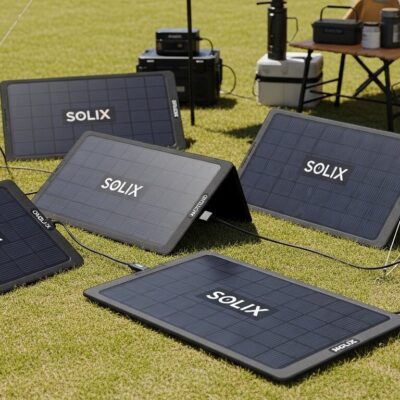
The Anker SOLIX SolarBank is their balcony solar battery system — a plug-and-play unit that combines solar panel input with battery storage and grid interaction in a format designed for apartments, renters, and homes where rooftop solar is not permitted. It connects balcony or window-mounted solar panels to a wall outlet, generates solar power during the day, stores excess in its integrated battery, and draws from battery when solar input falls short.
The SolarBank represents a genuinely new product category: solar power for people who previously had no access to it — renters, apartment dwellers, and homeowners in HOA communities that restrict rooftop solar. No installation required, no permits needed, no contractor involved.
QUICK FACTS — ANKER SOLIX SOLARBANK
| System type: Plug-and-play balcony solar battery Solar input: Compatible with Anker SOLIX solar panels (PS100, PS200, PS400) Battery storage: Integrated — stores excess solar for later use Installation: Plug into standard wall outlet — no electrician, no permits Best for: Renters, apartments, homes with HOA solar restrictions, starter solar Grid interaction: Feeds stored solar to home loads via standard outlet Warranty: Varies by configuration — check product listing |
RATINGS
| Power Output | Value | Ease of Use | Best for |
| 3/5 — limited by balcony panel capacity | 5/5 — most accessible entry point | 5/5 — truly plug and play | Renters, apartments, starter solar users |
Solar or Battery: Which to Buy First?
This is one of the most common questions from new solar buyers. The answer depends on your use case:
Buy solar panels first if: you have a power station or compatible battery storage and want to reduce your electricity bill or charge a backup system. Solar panels generate free electricity — every kWh generated during the day that you use immediately saves a kWh from the grid.
Buy battery storage first if: you have reliable grid power but experience frequent outages, or if you pay Time-of-Use electricity rates and want to store off-peak cheap power for use during peak expensive periods. A battery without solar still provides backup and can save money on Time-of-Use rates.
Buy both together (SolarBank or F3800 + panels) if: you want the complete system that generates free power and stores it for use at any time. This is the optimal configuration for maximum savings and maximum resilience.
Power Bank Solar Power Bank: Portable vs Stationary Storage
Consumer solar power banks (portable solar chargers with integrated battery) are designed for phone and tablet charging on the go — they typically store 10,000–50,000 mAh (37–185 Wh) and output via USB. They are excellent for hiking, travel, and camping phone charging.
Anker SOLIX’s products are a different category entirely — they are solar power stations, not solar power banks. The entry-level C800 stores 768 Wh (approximately 4–20× more than a consumer solar power bank), has AC outlets for household appliances, and charges from solar panels at 200W input. The F3800 stores 3,840 Wh with solar input up to 2,400W. These are home and RV backup systems, not portable phone chargers.
| Feature | Consumer Solar Power Bank | Anker SOLIX Power Station |
| Capacity | 10,000–50,000 mAh (37–185 Wh) | 768 Wh to 3,840 Wh (F3800) |
| Output | USB-A, USB-C | AC outlets (120V/240V) + USB |
| Appliances powered | Phones, tablets, small devices | Any household appliance |
| Solar input | 5–50W (trickle) | 100–2,400W (meaningful) |
| Price | $20–$150 | $299–$2,499+ |
| Use case | Travel, hiking, phone charging | Home backup, RV, emergency power |
| ✅ Pros SolarBank makes solar accessible for renters and apartments No permits, no installation, no contractor — genuinely plug and play Reduces electricity bill immediately — every solar kWh generated offsets grid use Solar power bank integrates seamlessly with SOLIX panel range | ⚠️ Consider Balcony solar is limited by panel area and sunlight angle — lower output than rooftop SolarBank output is limited compared to F3800 or E10 for large loads HOA restrictions on balcony equipment may apply even without roof penetration |
| 🛒 Anker SOLIX Solar Panel Battery Bank SolarBank + compatible solar panels — plug-and-play solar for apartments and renters. → Shop on Anker SOLIX |
#2 — Anker SOLIX F3800 as a Home Battery: Complete Review
How the F3800 functions as a home solar battery — and why it is the most versatile battery storage solution at this price point.
The F3800 as a Solar Battery Bank: How It Works
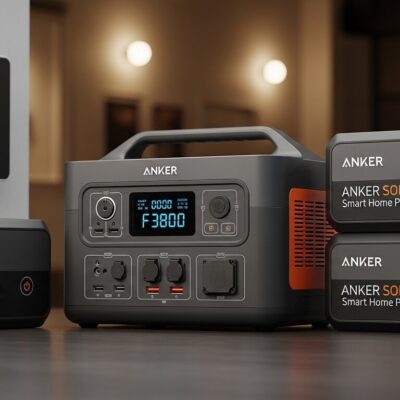
The Anker SOLIX F3800 is marketed as a portable power station, but its functionality as a home solar battery is arguably its most compelling use. With 3,840Wh of LiFePO4 battery storage, 2,400W solar input (up to 6 solar panels), and 6,000W AC output at 120V/240V, it performs the same function as a home battery like the Tesla Powerwall — but portably and without professional installation.
The solar charging sequence: solar panels generate DC electricity → F3800’s built-in MPPT solar charge controller optimizes the conversion → electricity stored in the LiFePO4 battery → F3800’s built-in pure sine wave inverter converts to 120V/240V AC on demand. The entire system is self-contained — no separate solar charge controller, inverter, or battery management system required.
QUICK FACTS — F3800 AS SOLAR BATTERY
| Battery type: LiFePO4 (Lithium Iron Phosphate) — safest lithium chemistry Battery capacity: 3,840 Wh base · expandable to 26.9 kWh with 6× BP3800 expansion batteries Solar input: Up to 2,400W (6× solar panel connections via MC4) Solar charge time: 4× 400W panels = full charge in approximately 3–4 hours of peak sunlight AC output: 6,000W continuous (pure sine wave) · 120V and 240V Battery lifespan: 3,000+ charge cycles · 10-year design life Smart features: App monitoring · energy usage tracking · charging schedule Warranty: 5 years |
RATINGS
| Power Output | Value | Ease of Use | Best for |
| 5/5 — 6,000W covers whole home | 5/5 — 10-year lifespan justifies investment | 5/5 — no installation required | Home solar battery, emergency backup, RV, whole-home power |
F3800 vs Tesla Powerwall: The Honest Comparison
| Factor | Anker SOLIX F3800 | Tesla Powerwall 3 |
| Battery capacity | 3.84 kWh (expandable to 26.9 kWh) | 13.5 kWh |
| AC output | 6,000W | 11,500W |
| Installation | Zero — plug and play | Professional installation required — $1,500–$3,000 |
| Permits | Not required for portable use | Required — electrical permits and inspection |
| Solar integration | Yes — direct panel input (MC4) | Yes — grid-tied with solar inverter |
| Price | ~$2,499 (base unit) | ~$9,900 + installation |
| Portability | Yes — wheeled, portable | No — wall-mounted permanently |
| Warranty | 5 years | 10 years |
| Best for | Portable backup · renters · RV · starter home battery | Permanent whole-home installation with rooftop solar |
Anker SOLIX BP3800 Expansion Battery: Scaling the F3800
The BP3800 is Anker SOLIX’s expansion battery for the F3800 system — adding another 3,840Wh of LiFePO4 storage per unit. Up to 6 expansion batteries can be connected to a single F3800, scaling total storage to 26.9 kWh. This transforms the F3800 from a single-day backup system to a multi-day home battery solution: at 1,000W average home load, 26.9 kWh provides approximately 26 hours — more than a full day of whole-home backup without any solar input, significantly longer with panels.
Each BP3800 expansion battery carries the same 10-year design life and LiFePO4 chemistry as the base F3800 — they are not a compromise or downgrade, they are identical technology in a stackable form factor.
| ✅ Pros LiFePO4 chemistry — safest, most stable lithium battery available Expands from 3.84 kWh to 26.9 kWh — scales to your backup needs No installation required — plug and play expansion5-year warranty · 10-year lifespan · 3,000+ charge cycles Portable — take it camping, RVing, or to a worksite 120V/240V output covers 100% of home appliances | ⚠️ Consider 3.84 kWh base is less than a Tesla Powerwall — need expansion for multi-day backup Heavy — approximately 130 lbs with wheels, not easy to move daily Not a permanent wall-mounted solution — less elegant aesthetically than dedicated home batteries |
| 🛒 Anker SOLIX F3800 + BP3800 Expansion Battery 3.84 kWh to 26.9 kWh · 6,000W · LiFePO4 · 5-year warranty · Free shipping. → Shop on Anker SOLIX |
#3 — Anker SOLIX E10 Battery System: Whole-Home Storage
6–30 kWh · 10kW output · 9kW solar · Storm Guard · Time-of-Use optimization — the complete home battery system.
What is the Anker SOLIX E10 Battery System?
The E10 is Anker SOLIX’s permanent home battery system — the direct competitor to the Tesla Powerwall and LG Energy Solution RESU series. Unlike the portable F3800, the E10 is designed for permanent installation (outdoor NEMA 4 rated enclosure), integrates with the home’s electrical panel, monitors grid power continuously, and automatically switches to battery backup during outages with zero interruption.
The E10 represents the most sophisticated product in the Anker SOLIX range — it won the 2026 iF Design Award specifically for making whole-home energy storage intelligent and accessible. Its Storm Guard feature pre-charges the battery automatically when severe weather is forecast, ensuring maximum backup capacity before a storm-induced outage.
QUICK FACTS — ANKER SOLIX E10
| Battery capacity: 6 kWh base · expandable to 30 kWh with B6000 battery modules AC output: 10 kW Turbo Output · up to 30 kW with expansion Solar input: 9 kW maximum — accepts up to 4,500W per PV input (2 inputs) Battery chemistry: LiFePO4 — UL9540 and UL9540A certified Grid integration: Time-of-Use mode · net metering compatible Storm Guard: Auto-charges before predicted severe weather Circuit management: Up to 12 circuits prioritized during outage Installation (Smart Inlet Box): DIY — no electrician required Installation (Power Dock): Electrician required for automatic backup NEMA rating: NEMA 4 (IP66) — outdoor weatherproof rated Warranty: 5 years |
RATINGS
| Power Output | Value | Ease of Use | Best for |
| 5/5 — 10kW handles full home | 5/5 — bill reduction pays back investment | 4/5 — smart inlet is DIY, power dock needs pro | Permanent whole-home battery · bill reduction · solar integration |
Anker SOLIX E10 vs Tesla Powerwall 3: Full Comparison
| Factor | Anker SOLIX E10 | Tesla Powerwall 3 |
| Base capacity | 6 kWh | 13.5 kWh |
| Maximum capacity | 30 kWh (5 modules) | Stackable with multiple units |
| AC output | 10 kW (30 kW with expansion) | 11.5 kW |
| Solar input | 9 kW | 11.5 kW (with solar panels) |
| Grid interaction | Time-of-Use · net metering | Powerwall app optimization |
| Storm Guard | Yes — auto pre-charge | Yes — Storm Watch |
| DIY installation option | Yes — Smart Inlet Box | No — electrician required |
| Price | Lower | Higher |
| Ecosystem | Anker SOLIX panels + power stations | Tesla solar panels preferred |
| Award | 2026 iF Design Award | Industry veteran |
How the E10 Reduces Your Electric Bill: Time-of-Use Explained
Time-of-Use (TOU) pricing is an electricity tariff structure where the price per kWh varies by time of day. Peak periods (typically 4–9 PM) are 2–4× more expensive than off-peak periods (midnight–6 AM). The E10 exploits this price differential automatically:
- Off-peak (midnight, 8 cents/kWh): E10 charges from the grid
- Solar hours (9 AM–3 PM): E10 charges from solar panels (free)
- Peak hours (4–9 PM, 28 cents/kWh): E10 discharges to home loads (avoiding grid purchase)
Daily saving on a 6 kWh system: 6 kWh × (28 cents peak − 8 cents off-peak) = $1.20/day = $438/year on electricity cost arbitrage alone, before solar savings. The system pays for itself through bill savings while also providing backup power — the payback period for the E10 in high-TOU markets is typically 6–9 years.
| ✅ Pros Automatic outage switching — zero interruption (Power Dock configuration) Storm Guard pre-charges before severe weather — maximum backup before storms Time-of-Use optimization earns $400–$800+/year in bill savings (TOU markets)9 kW solar input — integrates with substantial rooftop solar system NEMA 4 weatherproof — permanent outdoor installation2026 iF Design Award — recognized for innovation and accessibility Compatible with most third-party generators for extended backup | ⚠️ Consider Power Dock (automatic) version requires licensed electrician installation 6 kWh base is less than some competitors — expansion required for multi-day backup Smart features require stable Wi-Fi and smartphone for full functionality Higher upfront cost than portable F3800 — payback through bill savings over time |
| 🛒 Anker SOLIX E10 Whole-Home Battery System 6–30 kWh · 10kW output · Storm Guard · Time-of-Use · 5-year warranty. → Shop on Anker SOLIX |
#4 — Why Is My Electric Bill So High? The Solar Battery Solution
5,400 monthly searches — rising energy costs have a solution. Here’s how Anker SOLIX addresses it.
Why US Electricity Bills Are Rising Sharply
US residential electricity prices rose approximately 26% between 2021 and 2024. The causes are structural: aging grid infrastructure (the average US power transformer is 40 years old — past its expected lifespan), increasing fuel costs for gas-fired peak generation, extreme weather events driving demand spikes, and utilities passing grid upgrade costs directly to consumers. In California, average residential electricity is now above 30 cents/kWh in peak periods — triple the national average of a decade ago.
Three Ways Anker SOLIX Reduces Your Bill
1. Direct Solar Offset: Each kWh generated by your SOLIX panels during the day replaces a kWh you would have purchased from the grid. At 25 cents average US rate, a 400W panel generating 1.5 kWh/day saves approximately $136/year. Four panels = $544/year savings. The panels pay for themselves in 6–7 years, then generate free savings for 15–20 more.
2. Time-of-Use Arbitrage: The E10 charges during cheap off-peak hours and discharges during expensive peak hours. In markets with 3:1 peak-to-off-peak ratios, the daily saving on a 6 kWh system is $1.20/day = $438/year — purely from shifting the time you consume electricity, without generating any solar power.
3. Net Metering Export: In 40+ US states with net metering laws, excess solar generated by your panels and not consumed by your home feeds back to the grid, and the utility credits your account at the retail electricity rate. A well-sized solar + E10 system can turn the electricity bill into a credit each month during summer months.
How Many Solar Panels to Power a House? The Real Math
Average US home energy consumption: 30 kWh/day. Average peak sun hours by location: 4 hours (Northeast) to 6 hours (Southwest). Solar panels needed: 30 kWh ÷ 5 hours ÷ 0.85 (system efficiency) = 7,059W = approximately 18× 400W panels for primary coverage.
For Anker SOLIX: the E10 supports up to 9 kW of solar input = approximately 22–23× 400W panels. Combined with the E10’s 6–30 kWh battery storage, this configuration can achieve meaningful grid independence in most US locations — particularly in the Sun Belt states.
SOLAR SAVINGS CALCULATOR — EXAMPLE SCENARIOS
| Scenario | System | Monthly Savings | Payback Period |
| Camping + emergency use | 2× PS400 + F3800 | $30–$50 (fuel saved) | 5–7 years |
| Home backup only | F3800 + 2× BP3800 | $0 direct savings (resilience value) | N/A |
| Partial solar offset | F3800 + 4× PS400 | $40–$80/month | 6–8 years |
| TOU optimization only | E10 (no solar) | $30–$50/month TOU | 10–14 years |
| Full solar + storage | E10 + 18× 400W panels | $100–$200/month | 7–10 years |
| E10 + solar (TOU market) | E10 + solar in CA/TX | $150–$300/month | 5–7 years |
| ✅ Pros Solar generation completely eliminates fuel cost for every kWh generated TOU optimization earns $400–$800+/year in bill savings in suitable markets Payback periods of 5–10 years, then decades of free or near-free power Property value increases ~4% with solar installation (US averages) Energy independence reduces exposure to future utility rate increases | ⚠️ Consider Savings vary significantly by location, local electricity rates, and sunlight hours Initial investment is substantial ($2,499–$10,000+ for complete systems Full payback takes years — not suitable if you plan to move within 2–3 years |
| 🛒 Anker SOLIX — Reduce Your Electric Bill with Solar + Storage SolarBank · F3800 · E10 · Solar Panel Kits — every scale of solar storage solution. → Shop on Anker SOLIX |
Final Verdict — Which Anker SOLIX Battery Storage to Buy?
Quick guide based on your situation:
- Renter / apartment / no installation: SolarBank — plug-and-play, no permits
- First home battery purchase: F3800 — versatile, portable, zero installation
- Home backup + camping + RV: F3800 + 2–4× PS400 solar panels
- Multi-day home backup: F3800 + 1–6× BP3800 expansion batteries
- Permanent home battery (manual backup): E10 Smart Inlet Box — DIY install
- Permanent whole-home automatic backup: E10 Power Dock — electrician install
- Bill reduction + solar integration: E10 with Time-of-Use optimization + rooftop solar
- Maximum whole-home solar self-sufficiency: E10 + 18–22× 400W panels
All Anker SOLIX battery and solar products at ankersolix.com — 5-year warranty · free shipping · 0% APR financing available on select products.
| 🛒 Shop All Anker SOLIX Battery Storage SolarBank · F3800 · BP3800 Expansion · E10 — the complete home energy ecosystem. → Shop on Anker SOLIX |
Disclosure: This post contains affiliate links. If you purchase through our links we may earn a small commission at no extra cost to you. We only recommend products we have researched and genuinely believe in.