
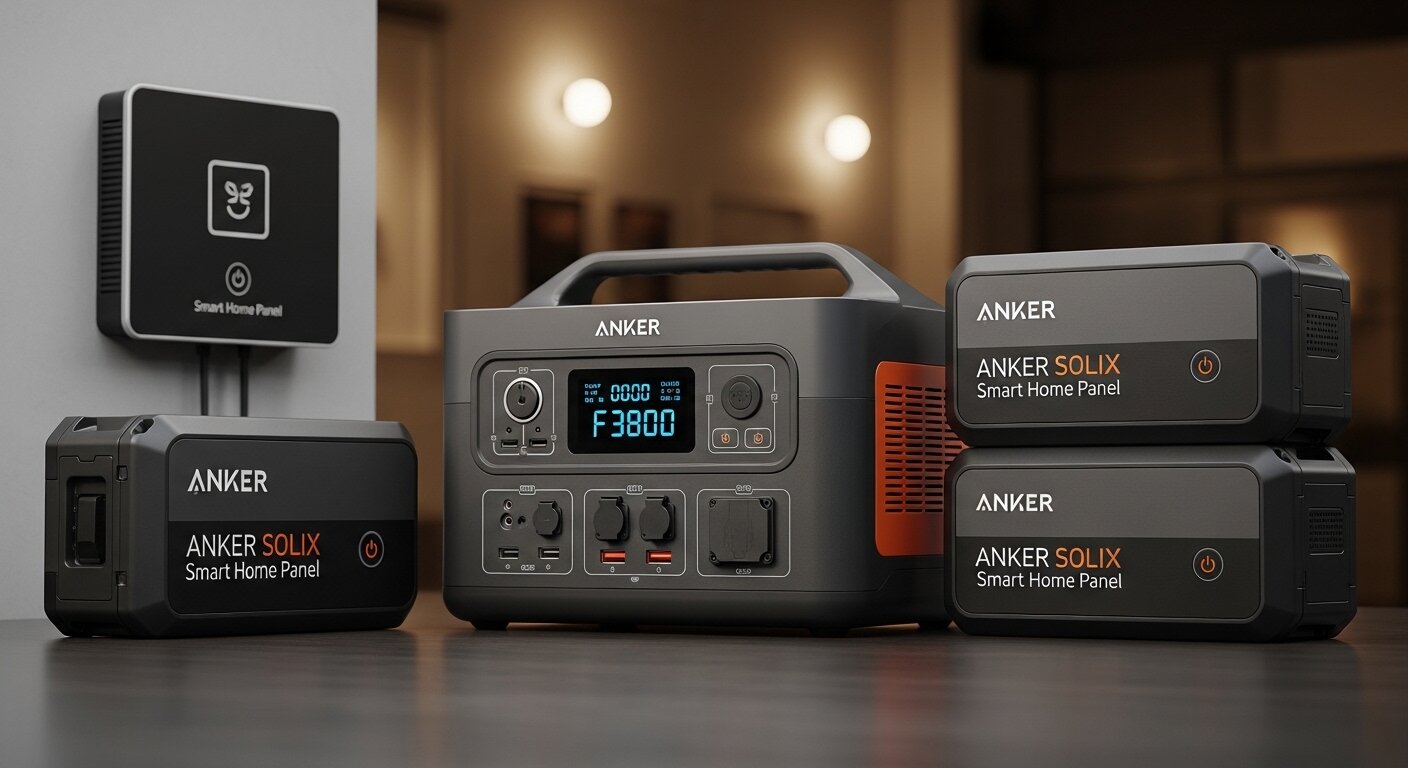

Power outages in the US are getting longer and more frequent — the average American experiences approximately 8 hours of power outages per year, a figure that has tripled in the last two decades due to aging grid infrastructure and increasingly severe weather. The traditional response — a gas generator — is loud, produces toxic carbon monoxide, requires fuel storage, and cannot run indoors or in a garage. Anker SOLIX offers a fundamentally different solution.
This guide reviews every Anker SOLIX home backup product — from the portable F3800 power station to the whole-home E10 system — comparing them honestly against traditional generators, explaining what each product powers, and helping you choose the right system for your home and budget.
All products at ankersolix.com — free shipping · 5-year warranty on most products.
| 🛒 Anker SOLIX Home Backup Systems F3800 · F3800 Plus · E10 · Solar Generator kits — the complete home backup range. → Shop on Anker SOLIX |
#1 — Anker SOLIX F3800 Review: The Portable Home Generator
3,840Wh · 6,000W AC · 120V/240V · Expandable to 26.9kWh — the most capable portable power station available.
What is the Anker SOLIX F3800?
The F3800 is Anker SOLIX’s flagship portable power station — a wheeled, 3,840Wh LiFePO4 battery system with a built-in 6,000W pure sine wave inverter. At 120V/240V split-phase output, it can run everything in your home that a traditional generator would power — including high-voltage appliances like central air conditioning, electric dryers, and EV chargers. It charges via solar panels (up to 2,400W solar input), wall outlet, or a gas generator.
QUICK FACTS — ANKER SOLIX F3800
| Battery capacity: 3,840Wh (3.84 kWh) — expandable to 26.9kWh with 6 expansion batteries AC output: 6,000W continuous (pure sine wave) · 12,000W with 2 units Voltage: 120V/240V split-phase — runs all household appliances Solar input: Up to 2,400W (dual 60V) — full charge in approximately 1.5 hours Charge time (wall): Approximately 2 hours from 0–100% on 240V EV charging: Yes — direct via NEMA 14-50 at up to 6,000W RV compatibility: Yes — NEMA 14-50 and L14-30 ports for direct RV connection Battery type: LiFePO4 — 10-year lifespan, 3,000+ charge cycles Warranty: 5 years — industry-leading Weight: Approximately 130 lbs — includes wheels and handles |
RATINGS
| Power Output | Value | Ease of Use | Best for |
| 5/5 — 6,000W runs whole home | 5/5 — 10-year lifespan justifies cost | 5/5 — plug and play, no installation | Home backup, power outages, RV, emergency preparedness |
What Does the Anker SOLIX F3800 Power — and For How Long?
The F3800’s 3,840Wh capacity translates to real-world backup duration:
- Refrigerator (150W): approximately 25 hours continuous
- Central AC (1,500W): approximately 2.5 hours continuous
- Window AC (1,000W): approximately 3.8 hours continuous
- Refrigerator + lights + router + devices (500W total): approximately 7 hours
- Full home essential loads (refrigerator, AC, lighting, devices = 2,000W): approximately 1.9 hours
With 4× PS400 solar panels (1,600W input), the F3800 can maintain essential loads indefinitely during daylight hours and extend battery backup through cloudy periods significantly.
How Many Watts Does a Refrigerator Use? (F3800 Sizing Guide)
A standard modern refrigerator uses approximately 100–200W continuously, with startup surges up to 600W for compressor activation. The F3800’s 6,000W peak output handles any refrigerator surge effortlessly. For daily power consumption: a typical refrigerator uses approximately 1–2 kWh per 24 hours — meaning the F3800’s 3.84 kWh capacity can power a refrigerator alone for approximately 2 full days.
Anker SOLIX F3800 vs F3800 Plus: What Changed?
| Spec | F3800 Plus (2025) | F3800 (Original) |
| Battery capacity | 3,840Wh | 3,840Wh (same) |
| AC output | 6,000W (3,300W single unit) | 6,000W |
| Solar input | 3,200W (dual 165V) | 2,400W (dual 60V) |
| Full solar charge | Under 2 hours | Approximately 1.5 hours |
| Generator compatibility | 240V generators | 120V generators |
| Max expandable capacity | 53.8kWh | 26.9kWh |
| Price | Higher | Lower |
| Best for | Maximum solar input · future expansion | Strong value · standard home backup |
Home Generator Cost: F3800 vs Traditional Gas Generator
| Factor | Anker SOLIX F3800 | Traditional Gas Generator |
| Purchase price | ~$2,499 (varies) | $800–$3,000 (comparable wattage) |
| Fuel cost | $0 (solar chargeable) | $40–$80/day at 8 hours run time |
| Installation | Zero — plug and play | Transfer switch recommended ($500–$1,500) |
| Noise level | Silent | 65–80 dB — equivalent to a vacuum cleaner |
| Carbon monoxide | Zero — safe indoors | Toxic — must run outdoors |
| Maintenance | Minimal (battery check) | Oil changes, spark plugs, fuel stabiliser |
| Lifespan | 10+ years | 3–5 years average |
| 5-year total cost | ~$2,499 + $0 fuel | $800–$3,000 + ~$3,000+ fuel |
| ✅ Pros Silent — no noise restrictions, no neighbour complaints Zero carbon monoxide — safe to run inside garage or home Solar chargeable — can provide indefinite power in sunny conditions EV and RV direct charging built in — no additional equipment 5-year warranty · 10-year lifespan — lower long-term cost than gas generator Expandable to 26.9kWh with expansion batteries — scales with your needs | ⚠️ Consider Higher upfront cost than a basic gas generator Heavy at ~130 lbs — wheeled but not truly portable Cannot provide indefinite power in extended cloudy, no-sun situations without grid charging |
| 🛒 Anker SOLIX F3800 Portable Power Station 3,840Wh · 6,000W · 120V/240V · 5-year warranty · Free shipping. → Shop on Anker SOLIX |
#2 — Anker SOLIX E10 Whole-Home Backup System Review
The world’s first smart hybrid whole-home backup — 6–30kWh · 10–30kW output · 9kW solar input. 2026 iF Design Award winner.
What is the Anker SOLIX E10?
The E10 is Anker SOLIX’s whole-home backup system — a permanently installed (no electrician required for the Smart Inlet Box configuration) battery system that monitors your home’s power, automatically switches to backup during outages, and integrates with both solar panels and the utility grid for intelligent energy management. It won the 2026 iF Design Award for making advanced home energy technology intuitive and accessible.
Unlike the F3800 (which you manually connect and manage), the E10 is always-on — monitoring grid power continuously, automatically charging when rates are low, automatically switching to backup during outages (with zero interruption), and intelligently prioritising power across up to 12 circuits when backup capacity is being conserved.
QUICK FACTS — ANKER SOLIX E10
| Battery capacity: 6kWh base · expandable to 30kWh with additional B6000 modules Output: 10kW Turbo Output · up to 30kW with expansion Solar input: 9kW — accepts up to 4,500W per PV input (2 inputs) Weather response: Storm Guard — automatically pre-charges before severe weather Grid integration: Smart grid — Time-of-Use mode charges on off-peak rates Circuit management: Prioritises up to 12 circuits during backup Installation: Smart Inlet Box = no electrician · Power Dock = automatic backup (electrician needed) Weatherproofing: NEMA 4 (IP66) — outdoor rated Warranty: 5 years Award: 2026 iF Design Award |
RATINGS
| Power Output | Value | Ease of Use | Best for |
| 5/5 — whole-home capable | 5/5 — pays for itself via bill reduction | 4/5 — smart inlet = DIY, power dock = electrician | Whole-home backup, energy bill reduction, solar integration |
Anker SOLIX E10 vs F3800: Which is Right for You?
Choose F3800 if: you want portable backup you can take camping, RVing, or to a worksite. You want a system you can install yourself in minutes. Your backup needs are for essential appliances during outages, not whole-home coverage. You want to start smaller and potentially expand later.
Choose E10 if: you want whole-home backup with automatic switching (zero interruption during outages). You want to reduce your electricity bill through Time-of-Use optimization. You have or plan to have a rooftop solar system and want to integrate battery storage. You want a permanent system that manages itself without manual intervention.
Does the Anker SOLIX E10 Need a Transfer Switch?
The E10 Smart Inlet Box configuration does not require a traditional transfer switch — it uses a different approach (smart inlet) that allows whole-home backup without electrician installation. The E10 Power Dock (for automatic backup switching) does require professional installation. This distinction is important: the Smart Inlet Box version is a genuine DIY installation; the Power Dock version provides fully automatic backup but needs an electrician.
Anker SOLIX E10 and the Electric Bill: How Much Can It Save?
In Time-of-Use pricing markets (California, Texas, New York, and most US states), electricity costs 2–4× more during peak hours (typically 4–9 PM) than off-peak. The E10 can charge from the grid during off-peak hours (e.g., midnight at 8 cents/kWh) and discharge during peak hours (4 PM at 28 cents/kWh), saving the difference. Anker markets the E10 as capable of reducing electricity bills by up to 80% in optimal Time-of-Use scenarios. Real-world savings depend heavily on local utility rates and usage patterns.
| ✅ Pros Automatic outage switching — zero interruption, no manual connection Storm Guard — pre-charges automatically before predicted severe weather Time-of-Use optimization — charges cheap, discharges expensive = bill savings Integrates with rooftop solar — the complete home energy system Scales from 6kWh to 30kWh with additional battery modules NEMA 4 weatherproof — outdoor installation capable2026 iF Design Award — recognized for design excellence and accessibility | ⚠️ Consider Automatic backup (Power Dock) requires licensed electrician installation Higher initial cost than portable F3800 solution Requires stable Wi-Fi for smart features to function Battery capacity is fixed per module — unlike F3800 which can add multiple expansion packs |
| 🛒 Anker SOLIX E10 Whole-Home Backup System 6–30kWh · 10kW output · 9kW solar · Storm Guard · Smart grid · 5-year warranty. → Shop on Anker SOLIX |
#3 — Inverter Generator vs Regular Generator: The Complete Comparison
27,100 monthly searches — the question everyone asks before buying a generator. The honest answer.
What is an Inverter Generator? How It Works
A traditional generator produces AC power by rotating magnets past wire coils — the output frequency fluctuates with engine speed, producing ‘dirty’ power with voltage and frequency variations. An inverter generator adds a step between the engine and the output: it generates DC power, then converts it back to AC via a digital inverter, producing clean, stable, grid-quality power. The inverter also allows the engine to throttle down when less power is needed, significantly improving fuel efficiency and reducing noise.
Inverter Generator vs Regular Generator: Pros and Cons
| Factor | Inverter Generator | Regular Generator |
| Power quality | Clean sine wave — safe for electronics | Dirty power — can damage sensitive devices |
| Noise level | 50–60 dB — significantly quieter | 65–80 dB — very loud |
| Fuel efficiency | Better — engine throttles to demand | Poor — runs at fixed RPM regardless of load |
| Weight | Lighter — typically 40–70 lbs | Heavier — typically 100–250 lbs |
| Power output | Typically 1,000–7,000W | Up to 15,000W+ |
| Price | Higher per watt | Lower per watt |
| Best for | Electronics, camping, quiet use | Heavy equipment, construction, high wattage |
Why Anker SOLIX is Better Than Both Types of Generator
Anker SOLIX power stations (F3800, E10) are fundamentally different from either generator type — they use no combustion engine at all. This eliminates the core disadvantages of all generators: no carbon monoxide, no noise, no fuel storage, no maintenance schedule, no outdoor-only restriction. The F3800’s pure sine wave output is cleaner than even the best inverter generator, and at 6,000W output it outperforms most consumer inverter generators.
The remaining advantage of a traditional generator over Anker SOLIX is extended runtime without sunlight — a gas generator can run indefinitely as long as you add fuel. For this use case, Anker SOLIX now offers the Smart Generator 5500 — a tri-fuel inverter generator specifically designed to pair with the E10 system, extending its runtime during cloudy periods.
What is an Inverter Generator? Summary
An inverter generator is a generator that produces clean, stable power by converting its output through a digital inverter — safer for electronics, quieter, and more fuel-efficient than a regular generator. For home backup use, Anker SOLIX battery systems eliminate the need for any generator while providing better power quality, zero noise, and no carbon monoxide risk.
| ✅ Pros Anker SOLIX produces the cleanest power — cleaner than any inverter generator Zero noise — use indoors, in quiet campgrounds, or anywhere without noise restrictions Zero carbon monoxide — eliminates the single biggest generator safety risk Solar charging means zero ongoing fuel cost for typical outage durations Smart Generator 5500 available for extended runtime when solar is insufficient | ⚠️ Consider No combustion engine means Anker SOLIX depends on battery capacity — must charge to recharge Gas generators have effectively unlimited runtime (with fuel) — battery systems do not Very high continuous loads (10,000W+) still favor large traditional generators |
| 🛒 Anker SOLIX vs Generators — See the Full Range F3800 · E10 · Smart Generator 5500 · Solar Generator Kits. → Shop on Anker SOLIX |
#4 — Battery Backup Sump Pump: Anker SOLIX as the Power Source
4,400 monthly searches — flooding and power outages happen simultaneously. Here’s the Anker SOLIX solution.
Why Do Sump Pumps Need Battery Backup?
Sump pumps are critically important during exactly the scenarios when power outages are most likely — heavy rain and flooding events. A sump pump that fails during a power outage caused by a storm can result in basement flooding, structural damage, mold, and losses of tens of thousands of dollars. Traditional battery backup sump pumps use a dedicated lead-acid battery connected to the pump’s backup circuit — these batteries typically last 4–7 hours and require replacement every 2–3 years.
Anker SOLIX as a Sump Pump Power Source
The F3800 can power any 120V sump pump directly — most residential sump pumps draw 300–800W during operation. The F3800’s 3,840Wh capacity can run a 500W sump pump for approximately 7.5 hours continuously, or intermittently (as sump pumps cycle on and off) for 15–20+ hours. Combined with solar panel charging during a storm (even partial charging on overcast days), the F3800 can sustain sump pump operation through extended outages far beyond what a dedicated battery backup system can achieve.
How Many Watts to Run a House? (Power Sizing Guide)
To properly size an Anker SOLIX backup system, calculate your essential loads:
- Refrigerator: 100–200W continuous, 600W startup surge
- Sump pump: 300–800W when running, intermittent
- Central HVAC: 1,000–3,500W depending on size
- Window AC unit: 500–1,500W
- Lights (LED throughout home): 100–300W
- Router, modem, devices: 50–150W
- Medical equipment (CPAP, etc.): 30–100W
Essential loads (refrigerator + sump + lights + devices) typically total 800–1,200W. The F3800 at 6,000W output handles all of these simultaneously with significant headroom. Battery duration at 1,000W average load: approximately 3.8 hours — extend with solar panels or multiple expansion batteries.
| ✅ Pros 6,000W output handles any sump pump startup surge 3,840Wh base capacity powers sump pump through extended outages Solar charging during storm provides ongoing power replenishment Same system that backs up sump pump also backs up refrigerator, lights, and devices Expandable to 26.9kWh for multi-day outage protection | ⚠️ Consider F3800 is not a dedicated sump pump solution — it is a whole-home system Very heavy rains that reduce solar output can limit daytime recharging Cost is higher than a dedicated battery backup sump pump system |
| 🛒 Anker SOLIX F3800 — Home Backup Including Sump Pump 3,840Wh · 6,000W · 120V/240V · Expandable · 5-year warranty. → Shop on Anker SOLIX |
#5 — Why Is My Electric Bill So High? (And How Anker SOLIX Fixes It)
5,400 monthly searches — rising electricity costs are affecting every US household. The solar + storage solution explained.
Why Are Electricity Bills So High in 2025?
Average US electricity prices rose approximately 26% between 2021 and 2024, driven by: fuel price increases (natural gas and coal power generation costs), aging grid infrastructure (utilities passing upgrade costs to consumers), extreme weather events increasing demand spikes, and transmission losses from centralized generation. In California, Texas, New York, and Florida, residential electricity rates are now above 20–30 cents per kWh in peak hours.
How Anker SOLIX Reduces Your Electric Bill: Three Mechanisms
1. Solar Generation: Anker SOLIX solar panels generate free electricity during daylight. Every kWh generated by your panels is a kWh you don’t purchase from the grid. At 25 cents/kWh average, a 400W panel generating 1.5 kWh/day saves approximately $136/year — single panel, single location.
2. Time-of-Use Optimization (E10): The E10 charges from the grid during off-peak hours (cheap) and discharges during peak hours (expensive). In a market with 8 cents/kWh off-peak and 28 cents/kWh peak rates, the E10 earns the 20-cent spread on every kWh it cycles. With 6kWh of daily cycling, that is $1.20/day or $438/year — on one battery module alone.
3. Net Metering: In net-metering states, excess solar generation feeds back to the grid and credits your bill. The E10 with rooftop solar can turn a net electricity consumer into a net producer, eliminating the bill entirely in favorable locations.
How Many Solar Panels to Power a House?
A typical 2,000 sq ft US home uses approximately 30 kWh per day. In a location with 5 peak sun hours per day, the calculation is: 30 kWh ÷ 5 hours = 6,000W of solar panels needed. At 400W per panel, that is 15 panels for primary solar coverage. The Anker SOLIX E10 with 9kW solar input and 30kWh expandable battery supports this configuration as a complete whole-home solar-plus-storage system.
| ✅ Pros Solar panels eliminate fuel cost for generated electricity Time-of-Use optimization turns battery storage into a daily revenue mechanism Net metering can eliminate the electricity bill entirely E10 claims up to 80% bill reduction in optimal Time-of-Use scenarios System pays for itself — typical payback period 5–8 years, then free power | ⚠️ Consider Savings depend heavily on local electricity rates and solar irradiance Time-of-Use optimization requires a smart meter and compatible utility plan Full whole-home solar coverage requires significant panel quantity and investment |
| 🛒 Anker SOLIX E10 — Reduce Your Electric Bill Smart grid integration · Time-of-Use optimization · Up to 80% bill reduction. → Shop on Anker SOLIX |
Final Verdict — Which Anker SOLIX Backup System Should You Buy?
Quick guide based on your primary need:
- Power outage protection (essential appliances): F3800 — plug and play, $2,499
- Power outage + camping + RV: F3800 + PS400 solar kit — versatile
- Extended outage (multi-day): F3800 + BP3800 expansion battery — doubles capacity
- Whole-home automatic backup: E10 Smart Inlet Box — DIY install, automatic switching
- Whole-home backup + bill reduction: E10 with Time-of-Use optimization
- Whole-home backup + solar integration: E10 + rooftop solar system
- Emergency sump pump backup: F3800 — handles any residential sump pump for hours
All Anker SOLIX home backup products at ankersolix.com — 5-year warranty · free shipping on most orders.
| 🛒 Shop All Anker SOLIX Home Backup Products F3800 · F3800 Plus · E10 · Solar Generator Kits · Expansion Batteries. → Shop on Anker SOLIX |
Disclosure: This post contains affiliate links. If you purchase through our links we may earn a small commission at no extra cost to you. We only recommend products we have researched and genuinely believe in.